
NEWS
The Czech audiovisual industry took a pause in 2024 during the period of disadvantageous incentives and focused on preparing conditions for new growth
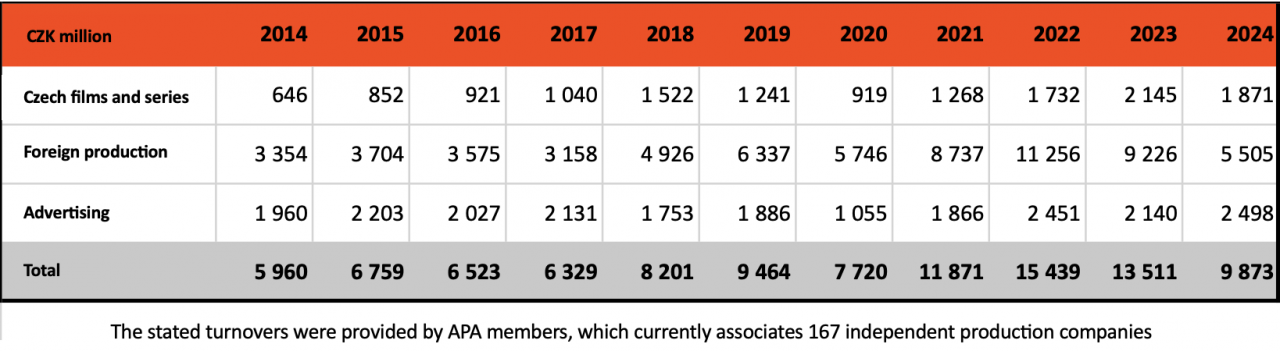
The Czech audiovisual sector reports an overall decline for the past year 2024 to just under 10 billion from the original 13.5 billion in 2023, representing a decrease of approximately 27%. There was an expected decline in foreign service productions by 40%, as the 20% incentives could not compete with other countries. The Audiovisual Producers' Association had forewarned of this fact – which is why it fought so hard for changes, such as increasing the incentive to 25% not only for foreign productions filming in the Czech Republic. Had these changes not occurred, the situation would have become unsustainable in the future. Demand from foreign productions for filming in the country is already growing thanks to a series of measures, but the return to the top is preceded by a long and gradual process of renewed growth. Where the audiovisual sector grew last year was in Czech VOD production and advertising. Czech animation is thriving on all fronts.
'The decline in 2024 reflects what the APA had warned about. If the government had not succeeded in reforming the audiovisual system, Czech audiovisual production would have fallen into stagnation or decline. Fortunately, this is not happening. From January 2025, we have a new Czech Audiovisual Fund with a doubled budget and improved incentives. This year thus brings growth and new opportunities again. And it's not just about the reform of the Fund; hand in hand with this came the long-needed reform of public television financing. Public television is a crucial investor in the audiovisual sector, including minority and non-commercial projects, documentaries, animation, and productions for children and youth. Czech audiovisual production remains very dynamic; viewers enjoy domestic content, and it's a pleasure to observe how private platforms and television stations are also growing, significantly investing in quality domestic productions. The domestic audiovisual industry has great potential, supported by strong creators and talent across generations. The key now will be the debate on how to ensure dignified conditions for their work. As producers, we want to advocate for a permeable, fair, and sustainable audiovisual sector,' says APA Chairman Vratislav Šlajer.
The amendment to the Audiovisual Act also brought another fundamental change, with the level of incentives for animation and digital production being as high as 35%. Moreover, incentives in the Czech Republic are very quickly accessible for filmmakers in terms of administration and advantageous regarding additional procedural financial expenditures. The amendment also introduced a separate pillar for animation and gaming. And thanks to creative vouchers, administered by the Ministry of Culture from the National Recovery Plan, an additional 200 million crowns has been added to the audiovisual sector.
The turnover of the advertising sector of just under 2.5 billion, after last year's slight decrease of 13%, has grown again and even exceeded the highest figure so far from 2022. Commissioned advertising production increased this year by as much as 400 million to a total turnover of 1.4 billion, due to factors such as a significant increase in the number of shooting days by 40%, and the overall growth of the economy. In line with the trend from previous years, mainly larger commissions are heading to the Czech Republic, while smaller one-day or two-day service projects either remain in their home country or continue to go to cheaper European countries. Competition with them, based primarily on the quality of professions in the Czech Republic, is nevertheless financially lost in advance. The exception is those who return to the country regularly and are willing to travel for shorter commissions because of the guaranteed 'production value'. Also interesting is the indicator of the average budget for foreign commissions, which, as in the previous year, is three times higher (3.7 billion) than for Czech advertising projects, even though this figure does not include fees for the main creators or post-production. This points to the fact that budgets for Czech advertising are still incomparably lower compared to foreign countries.
The Czech Republic, despite last year's significant decrease in the total volume of foreign audiovisual production, remains a key destination for international film projects. Last year, Prague hosted two exceptionally demanding and prestigious sci-fi productions. The first was the series Blade Runner 2099 for the Amazon Prime platform, which was produced in the Czech Republic by the production company Film United. Its preparations and filming in the second half of the year completely filled the premises of Barrandov Studios, including the adjacent grounds. The second was another series of Foundation, inspired by Isaac Asimov's classic book series. Production in the Czech Republic was provided by Milk and Honey Pictures. In 2024, the original German sci-fi series City of Blood for Disney+ was also filmed in the Czech Republic, and work continued on the second series of the historical drama The Empressfor Netflix.
The decline in foreign commissions was primarily caused by the loss of competitiveness of film incentives, with a significant portion of American and European productions thus moving elsewhere. Therefore, the APA had long supported the enactment of the amendment to the Audiovisual Act (effective from 1 January 2025), which increased the incentives. The year 2024 also revealed a shortage of studio capacity in the Czech Republic. The two largest projects occupied key studios at Barrandov and in Prague Studios for many months, including time outside of the actual filming. Other potential foreign projects therefore had to seek facilities elsewhere. The audiovisual industry worldwide faces changing viewer habits, high costs associated with the transition to new distribution models, and the impacts of Hollywood strikes, which significantly limited the development and realisation of new projects. Positive news includes preparations for establishing a representation of the Czech Film Commission in cooperation with the Consulate General of the Czech Republic in Los Angeles, which will significantly strengthen our presence in the centre of the global film and television industry. Our country is thus on the path to restoring its sovereign position among the leaders of European audiovisual production.
Czech VOD production recorded a record increase to 381 million, while there was a decline in films and series. However, Czech production continues its long-term upward trend, despite the volume being lower than in 2023. That year was exceptional due to the concurrence of several large projects. Overall, in the area of all Czech production, there was a decline of 13%, but in the previous year, an increase of 413 million was recorded. In addition, the amendment to the Audiovisual Act introduced a number of changes, with the new Czech Audiovisual Fund (CAF) focusing on supporting film production, documentary films, and series.
The APA continues to collaborate with regional film offices and regional cultural departments on the creation of regional grant programmes for the audiovisual sector. Last year, both new grant programmes in the Ústí nad Labem and Moravian-Silesian regions, financed from the Just Transition Operational Programme, became fully operational. In 2026, the Karlovy Vary region will join them. The amount that regions invest in the production of audiovisual works for cinemas, television, and VOD platforms has thus significantly increased and will increase further. Unfortunately, one of the most successful regional projects — the South Moravian Film Foundation Fund, which has long served as a model for other grant programmes and has exceptional results and a positive impact on the development of local audiovisual production, faces unprecedented pressure from the Ministry of Finance. It questions its existence, as well as that of other foundation funds established by local governments throughout the Czech Republic, including the Prague Audiovisual Fund. The APA fully supports regional governments, which disagree with the legal interpretation of the Act on Budgetary Rules of Territorial Budgets issued by the Ministry of Finance. Both audiovisual funds are maximally transparent, efficient, and enable the development of Czech and regional audiovisual production. The founders of the South Moravian Film Foundation Fund, the Statutory City of Brno and the South Moravian Region, are not currently proceeding with the termination of the fund's activities; however, they recommend limiting the fund's costs to necessary operational expenses and not entering into new commitments with applicants. The possibility of postponing the deadline for a decision until autumn this year is under negotiation.
For many years, we have witnessed great international successes in animation, achieved especially, but not only, by short, animated works created in the Czech Republic. Our country is known for its strong creative potential, represented by students and graduates of many animation schools. Czech producers have learned to seek out these talents and involve them in co-production projects that achieve high technical and content quality in their films. Many of them then gain international recognition and festival awards. A major prerequisite for strengthening the animation industry is particularly the current positive legislative changes. The APA endeavours to assist the process of animation industry development through events that lead, for example, to strengthening and creating co-production ties, educating professionals, or presenting Czech animation at international forums. The year 2024 represented another breakthrough and successes for Czech animation, with young animators making their mark worldwide and also collecting a number of awards in the Czech Republic. A total of nine animated films were selected to participate in the Annecy festival, Hungry for Life won the prestigious Contrechamp Jury Award, and films like Electra and Tony, Shelly and the Magic Light also scored well. Hungry for Life was even nominated in two categories, Best Animated Film and Best European Film, for the prestigious European Film Awards. The short film Weeds participated in a number of significant international festivals (in Cannes, Bucheon in Seoul, or Buenos Aires, winning awards at many of them).
Among the international successes of Czech films and documentaries for 2024 are world premieres at the Berlinale – I'm Not Yet Who I Want to Be (over 60 festivals in total) and The Newsroom. In Copenhagen at CPH:DOX, world premieres of documentaries The Borders of Europe and Lichens Are the Way took place. At the Karlovy Vary IFF, a total of 24 Czech films were presented, in competitions then Little Lights, Murder (Special Jury Recognition in the Main Competition), From March to May (Special Recognition in the Proxima Competition), Waves won the Main Audience Award, followed by Ema and the Death's-head Hawkmoth and Tony, Shelly and the Magic Light. At the Venice Film Festival, films After Party, It's in the Stars, and Fragile Home (VR) had their world premieres. At the international festival in Warsaw, 5 Czech films were presented – Cop Wars, The Widow's Year, Easter Monday, Joko, and the documentary War Reporter, which won the Best Feature Documentary Award. In Busan, the film The Other One was presented in its international premiere, and in Tokyo, the film The Sky Above Me, the Valley Within Me in its world premiere. At Tallinn Black Nights FF, a total of 13 films were presented, including American Girl in its international premiere and Nobody Likes Me in its world premiere. Last year, the Czech Republic also scored at the Oscars, with the student Oscar going to Countryman, which also made the shortlist in the Best Short Film category; the Czech candidate for the Oscar in the Best International Foreign Film category was Waves, which also made it onto the shortlist.
At the initiative of the APA, a number of studies are being created, the latest concerning viewer habits and film exportability (cross-border distribution from the producers' perspective). The study of viewer habits shows that interest in watching television is declining, with TV broadcasting giving way to time-shifted viewing among younger generations, and the popularity of VOD platforms is increasing. Among young people, the number of those who prefer foreign productions in the original language with subtitles is also increasing. There is an increasing number of people who have not been to the cinema even once a year, but those who do go, go more frequently. The main barrier to cinema attendance is the price of tickets and the early introduction of cinema premieres on platforms. At the same time, the main motive for visiting the cinema is no longer the technical quality of the screening, but the desire to see new releases and meet with friends. Fatigue from VOD platform subscriptions has also been recorded, with people beginning to prefer quality over quantity. Revenues in domestic cinemas went down year-on-year by just under 1% due to inflation, amounting to 2.26 billion. In the end, however, domestic cinemas were visited by only 2% fewer viewers, attendance was approximately 13 million viewers, which is a decrease of 290,000 viewers. There was a slight decrease in multiplex attendance.
APA – Audiovisual Producers' Association
Contact: Martina Reková, martina.rekova@4press.cz, +420 731 573 993, Klára Bobková, +420 731 514 462, klara.bobkova@4press.cz, Národní 28, Prague 1, www.asociaceproducentu.cz